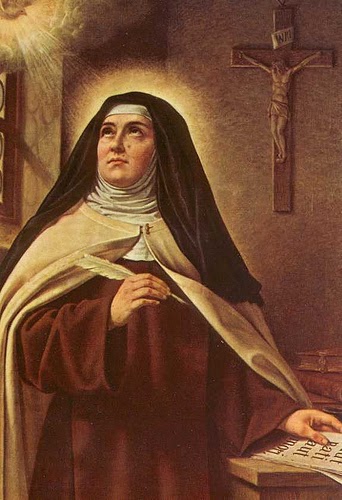
Feast Day: October
15
The Carmelite Order celebrates the feast of St.
Teresa of Jesus (Avila) October 15th. St.Teresa does not need any introduction.
She is famous among the laity and a shining luminary in the Catholic Church. She
is one of the three women Doctors of the Church, with St. Therese of Lisieux and
St. Catherine of Siena, being the other two. She is known as the Reformer of
Carmel, along with St. John of the Cross, and founded the Discalced Order of the
Carmelite family. The Teresian reform is not the only reform in Carmel. There
were other reforms including the Reform of Touraine in France (17th century) and
the Mantuan reform in Italy, which effected many changes in the Order. But St.
Teresa's reform was the most well known partly because of her own charismatic
personality and widespread influence. She was a very influential woman of her
day and collaborated with powerful people .
She wrote books
dealing with her Life and Prayer. To mention some of her famous works: The Life
(autobiographical), The Way of Perfection (written for her Nuns) and The
Interior Castle (on Prayer). There are a variety of commentaries written about
these books and you can check them out at http://www.icspublications.com/.
I
got to know St. Teresa in 1984 after I graduated from College. My favorite reading is her Way of Perfection
. It deals with the subject of prayer. I also like The Interior Castle when I am
trying to analyze what mansion I may be in! Although the Way of Perfection was
written for her nuns and is tailored to those living a solely contemplative
lifestyle, one can use her counsels in this book to know about prayer and how to
grow in the life of prayer. She summarized three preconditions for a life of
prayer: Humility, Detachment and Charity. The entire book expounds on these
three criteria.
One subject St. Teresa persistently wrote about was
how to pray . In her own life, she had a terrible time praying, to be specific
18 years, of not being able to pray. In her autobiography, she stated that she
needed the security of a book to get her focused. Even though most of the time
she did not read the book, she needed the security of having it with her for
reassurance. Because of her personal difficulties in praying, she is able to
explain to us through her writings difficulties we ourselves often experience.
She is very insistent about imagining Christ in His humanity. She imagined him
in those moments when he was most alone because she figured she will not be
turned away when he is so abandoned.
I thought of presenting a
little of her thoughts on Mental Prayer or meditation. I used the article
presented by Fr. Sam Anthony Morello OCD “Lectio Divina and the
Practice of Teresian Prayer”.
Lectio Divina (or divine
reading) is not particularly exclusive to Saint Teresa of Avila. It is an old
form of monastic prayer used throughout many centuries. It is a monastic
designation for meditative reading of the Scriptures. According to Fr. Morello’s
book, there are four steps to lectio divina:
1.
LectioMeaning “reading”, understood as the careful repetitious
recitation of a short text of Scripture.
2.
MeditatioMeaning “meditation”, an effort to understand the meaning
of the text and make it personally relevant to oneself.
3.
OratioMeaning “prayer”, a personal response to the text, asking for
the grace of the text.
4. ContemplatioMeaning
“contemplation.” It is gazing at length on something. The idea behind this
element is that sometimes with God’s infused grace, one is elevated beyond
meditation to an experiential contact with the divine presence, to God’s truth
and benevolence.
Applying the Teresian flavor to the basic
elements of lectio divina, we come to the following exercise:
1.
Teresa’s “lectio” Reading the Word of God with Teresa
She
counsels that when we start to pray, we must be aware of the following: who it
is who is praying (we are creatures), who it is we are praying to (God), what we
are praying for.
Attentiveness to what one is doing and saying is
the first of Teresa’s advice.
2. Teresa’s “meditatio” -
meditating with Teresa.
Saint Teresa counsels that one aid to
prayer is to find a companion at prayer. She is referring to taking Christ as
our companion in prayer. Whether one imagines Christ within oneself or before
the Blessed Sacrament (although Jesus’ presence in the Blessed Sacrament is not
imagined but a reality), or in the image of the crucifix. She teaches us to
think of God as very near to us or as within us, dwelling in our depths. With
Teresa we go where God is. Her advice is to locate God according to one’s
inclinations. There is no one way we ought to pray. We pray as we can, not as we
ought. Teresa also wants us to ‘think” of Christ. We address ourselves to him,
or we try to “hear” his words in Scriptures addressed to
us.
3. Teresa’s “Oratio” Prayerful expression with
Teresa.Teresa’s prayer is full of affectionate expression to
Christ. It is the prayer that comes out of a heart that begins to be filled with
love. The heart can express itself in a million ways. But here we implement the
Teresian principle of making Christ the object of that prayer. You can utter
words that come spontaneously to you. This is the part where prayer becomes a
conversation.
4. Teresa’s “Contemplatio”
Contemplating with Teresa.After going through the steps of
reading the text to feed the mind, meditating on the meaning of the text to move
the heart and praying the words or other emotions that come to heart. Teresa
describes a state of “resting” in the Lord. A new recollection of the soul, in
its innermost core, is experienced. With Teresa, we rest in the presence and
take a holiday from the work of meditation.
The fruits of contemplation
for Teresa is shown in the growth of virtues. For her, the virtues are the
flowers in the garden of the soul.
We have explained in summary
the exercise of mental prayer according to Saint Teresa of Avila. We should
endeavor to learn this exercise of mental prayer for our growth in the spiritual
life.
Prayer:
"God our Father, by Your Spirit you raised up Saint
Teresa of Jesus to show your Church the way to perfection. May her inspired
teaching awaken in us a longing for true holiness. Grant this through Christ our
Lord. Amen"
SHORT INTRODUCTION:
Known to her family as Teresa de Cepeda y Ahumada, she became the
reformer of Carmel, mother of the Discalced Carmelite nuns and friars,
"spiritual mother" (as is engraved under her statue in the Vatican
Basilica), patron of Catholic writers (from 1965) and Doctor of the
Church (1970), the first woman with Saint Catherine of Siena to ever
receive this last title. She was born at Avila in Castile, Spain, on
28th March 1515 and died in Alba de Tormes, near Salamanca, on 4th
October 1582 (a correction due to the Gregorian reform of the calendar
that year, as the following day was officially 15th October). She was
beatified in 1614, canonised in 1622 and her feast day occurs on 15th
October.
Her life needs to be understood in the light of the plan
which God had for her, with the great desires experienced in her heart,
with the mysterious illness to which she was subject in her youth (and
with the ill health from which she suffered throughout her life), and
with the "resistance" to divine grace for which she blamed herself more
than she should has. Running away from home, she entered the Carmel of
the Incarnation in Avila on 2nd November 1535. As a result, partly of
the prevailing conditions in the community and partly from her own
spiritual difficulties, she had to struggle before arriving at what she
called her conversion at the age of 39. But, benefitting from various
spiritual directors, she then began to make great strides towards
perfection.
In 1560, the idea first emerged of a new Carmel, where
the Rule could be followed more closely, and this was realized two
years later when the monastery of St. Joseph was founded without any
endowments and "following the Primitive Rule": a phrase that needs to
be clearly understood because both then and later it was a notion which
was more nostalgic and "heroic" than practical. Five years later Teresa
obtained from the Prior General of the Order, John Baptist Rossi, then
visiting Spain, permission to increase the number of monasteries and a
licence to found two communities of contemplative Carmelite friars
(later to be called Discalced) who would be the spiritual counterparts
of the nuns and, as such, able to help them. At the death of Saint
Teresa, there were 17 monasteries of nuns in the Reform, and the
communities of friars also quickly outstripped the original number, some
founded with permission from the Prior General Rossi but others,
especially those in Andalusia, established against his will, relying on
the approval of the apostolic visitators, the Dominican Vargas and the
young Discalced Carmelite Jerome Gracian (a close spiritual companion
of Teresa, for whom she vowed to do whatever he asked her, as long as
it was not contrary to God's law).
There followed a series of
unedifying quarrels, made worse by the interference of the civil
authorities and other outsiders, until in 1581, the Discalced were
formed into a separate Province. Saint Teresa was then able to write,
"Now all of us, Discalced and Calced, are at peace and nothing can
hinder us from serving the Lord".
Saint Teresa is among the most
important figures of all time for Catholic spirituality. Her works -
especially the four best known (The Life, The Way of Perfection, The
Mansions and The Foundations) - together with her more historical
works, contain a doctrine which encompasses the whole of the spiritual
life, from the first steps right up to intimacy with God at the centre
of the Interior Castle. Her Letters show her occupied with a great
variety of everyday problems. Her doctrine on the unity of the soul
with God (a doctrine which was intimately lived by her) follows the
Carmelite tradition which had preceded her and to which she herself
contributed in such a notable way, enriching it as well as passing the
tradition on, not only to her spiritual sons and daughters, but also to
the whole Church which she served so unsparingly. When she was dying,
her one joy was to be able to affirm that "I die a daughter of the
Church".
SOURCE: CARMELITE WEBSITE
Showing posts with label St Teresa of Jesus. Show all posts
Thursday, October 14, 2021
Tuesday, October 05, 2021
Novena to St. Teresa of Jesus- October 6
October 6th is the beginning of our novena to
Saint Teresa of Jesus (Avila). Novena is a nine day act of prayers for the purpose of either
petition or thanksgiving. It recalls the nine days that the Apostles and the
Blessed Virgin gathered in the Upper room in prayer from the time Jesus ascended
to heaven until the coming of the Holy Spirit on Pentecost.
For Carmelites and the devotees of St. Teresa, we thank God for the gift of this special Saint who gave herself for the life of the Church. Her famous last words: "I am a daughter of the Church" certainly spoke for her great love. We also invoke her, as part of the Church Triumphant, to continue to intercede for us who are still on this earth. Below are the prayers we recite for our special intentions:
FIRST DAY:
by St. Alphonsus Liguori
"O most amiable Lord Jesus Christ, we thank You for the great gift of faith and of devotion to the Holy Sacrament, which You did grant to Your beloved Teresa. We pray, by Your merits and by those of Your faithful Spouse, to grant us the gift of a fervent devotion toward the Most Holy Sacrament of the altar, where You O Infinite Majesty has obliged Yourself to abide with us even to the end of the world, and wherein You did so lovingly give Your whole self to us."
(Our Father, Hail Mary, Glory Be..)
O Jesus, who Teresa's beauteous soul
With thy love-dart didst fire,
Deep in my heart of hearts
Her own sweet longing love of thee inspire.
St. Teresa, pray for us.
That we may become worthy of the promises of Christ.
Let Us Pray:
Graciously hear us, O God, our salvation! that as we rejoice in the commemoration of the blessed virgin Teresa (our Mother) , so we may be nourished by her heavenly doctrine, and draw from thence the fervor of a tender devotion , through our Lord Jesus Christ, Your Son, who lives and reigns with You in the unity of the Holy Spirit, God forever and ever. Amen.
For Carmelites and the devotees of St. Teresa, we thank God for the gift of this special Saint who gave herself for the life of the Church. Her famous last words: "I am a daughter of the Church" certainly spoke for her great love. We also invoke her, as part of the Church Triumphant, to continue to intercede for us who are still on this earth. Below are the prayers we recite for our special intentions:
FIRST DAY:
by St. Alphonsus Liguori
"O most amiable Lord Jesus Christ, we thank You for the great gift of faith and of devotion to the Holy Sacrament, which You did grant to Your beloved Teresa. We pray, by Your merits and by those of Your faithful Spouse, to grant us the gift of a fervent devotion toward the Most Holy Sacrament of the altar, where You O Infinite Majesty has obliged Yourself to abide with us even to the end of the world, and wherein You did so lovingly give Your whole self to us."
(Our Father, Hail Mary, Glory Be..)
O Jesus, who Teresa's beauteous soul
With thy love-dart didst fire,
Deep in my heart of hearts
Her own sweet longing love of thee inspire.
St. Teresa, pray for us.
That we may become worthy of the promises of Christ.
Let Us Pray:
Graciously hear us, O God, our salvation! that as we rejoice in the commemoration of the blessed virgin Teresa (our Mother) , so we may be nourished by her heavenly doctrine, and draw from thence the fervor of a tender devotion , through our Lord Jesus Christ, Your Son, who lives and reigns with You in the unity of the Holy Spirit, God forever and ever. Amen.
Novena to St. Teresa of Jesus- October 7
SECOND DAY:
by St. Alphonsus Liguori
"O most merciful Lord, Jesus Christ! we thank You for the great gift of hope which You did grant to Your beloved Teresa. We pray You, by Your merits, and by those of Your holy spouse, to give us a great confidence in Your goodness, by reason of Your Precious Blood, which You have shed to its last drop for our salvation.
Our Father, Hail Mary, Glory Be..)
O Jesus, who Teresa's beauteous soul
With thy love-dart didst fire,
Deep in my heart of hearts
Her own sweet longing love of thee inspire.
St. Teresa, pray for us.
That we may become worthy of the promises of Christ.
Let Us Pray:
Graciously hear us, O God, our salvation! that as we rejoice in the commemoration of the blessed virgin Teresa (our Mother) , so we may be nourished by her heavenly doctrine, and draw from thence the fervor of a tender devotion , through our Lord Jesus Christ, Your Son, who lives and reigns with You in the unity of the Holy Spirit, God forever and ever. Amen. "
by St. Alphonsus Liguori
"O most merciful Lord, Jesus Christ! we thank You for the great gift of hope which You did grant to Your beloved Teresa. We pray You, by Your merits, and by those of Your holy spouse, to give us a great confidence in Your goodness, by reason of Your Precious Blood, which You have shed to its last drop for our salvation.
Our Father, Hail Mary, Glory Be..)
O Jesus, who Teresa's beauteous soul
With thy love-dart didst fire,
Deep in my heart of hearts
Her own sweet longing love of thee inspire.
St. Teresa, pray for us.
That we may become worthy of the promises of Christ.
Let Us Pray:
Graciously hear us, O God, our salvation! that as we rejoice in the commemoration of the blessed virgin Teresa (our Mother) , so we may be nourished by her heavenly doctrine, and draw from thence the fervor of a tender devotion , through our Lord Jesus Christ, Your Son, who lives and reigns with You in the unity of the Holy Spirit, God forever and ever. Amen. "
Novena to St. Teresa of Jesus- October 8
Third Day:
"O Most loving Lord Jesus Christ! We thank thee for the great gift of love which You did grant to Your beloved Teresa. We pray Thee by thy merits, and by those of Your most loving spouse, to give us the great, the crowning gift of Your perfect love."
Our Father.. Hail Mary.. Glory be..
O Jesus, who Teresa's beauteous soul
With thy love-dart didst fire,
Deep in my heart of hearts
Her own sweet longing love of thee inspire.
St. Teresa, pray for us.
That we may become worthy of the promises of Christ.
Let Us Pray:
Graciously hear us, O God, our salvation! that as we rejoice in the commemoration of the blessed virgin Teresa (our Mother) , so we may be nourished by her heavenly doctrine, and draw from thence the fervor of a tender devotion , through our Lord Jesus Christ, Your Son, who lives and reigns with You in the unity of the Holy Spirit, God forever and ever. Amen. "
"O Most loving Lord Jesus Christ! We thank thee for the great gift of love which You did grant to Your beloved Teresa. We pray Thee by thy merits, and by those of Your most loving spouse, to give us the great, the crowning gift of Your perfect love."
Our Father.. Hail Mary.. Glory be..
O Jesus, who Teresa's beauteous soul
With thy love-dart didst fire,
Deep in my heart of hearts
Her own sweet longing love of thee inspire.
St. Teresa, pray for us.
That we may become worthy of the promises of Christ.
Let Us Pray:
Graciously hear us, O God, our salvation! that as we rejoice in the commemoration of the blessed virgin Teresa (our Mother) , so we may be nourished by her heavenly doctrine, and draw from thence the fervor of a tender devotion , through our Lord Jesus Christ, Your Son, who lives and reigns with You in the unity of the Holy Spirit, God forever and ever. Amen. "
Novena St. Teresa of Jesus- October 9 Day 4
"O most sweet Lord Jesus Christ! We thank thee for the gift of great desire and resolution which thou didst grant to thy beloved Teresa, the she might love thee perfectly; we pray thee by thy merits and by those of thy most generous spouse, to give us a true desire, and a true resolution of pleasing thee to the utmost of our power.
Our Father.. Hail Mary.. Glory be..
O Jesus, who Teresa's beauteous soul
With thy love-dart didst fire,
Deep in my heart of hearts
Her own sweet longing love of thee inspire.
St. Teresa, pray for us.
That we may become worthy of the promises of Christ.
Let Us Pray:
Graciously hear us, O God, our salvation! that as we rejoice in the commemoration of the blessed virgin Teresa (our Mother) , so we may be nourished by her heavenly doctrine, and draw from thence the fervor of a tender devotion , through our Lord Jesus Christ, Your Son, who lives and reigns with You in the unity of the Holy Spirit, God forever and ever. Amen. "
Our Father.. Hail Mary.. Glory be..
O Jesus, who Teresa's beauteous soul
With thy love-dart didst fire,
Deep in my heart of hearts
Her own sweet longing love of thee inspire.
St. Teresa, pray for us.
That we may become worthy of the promises of Christ.
Let Us Pray:
Graciously hear us, O God, our salvation! that as we rejoice in the commemoration of the blessed virgin Teresa (our Mother) , so we may be nourished by her heavenly doctrine, and draw from thence the fervor of a tender devotion , through our Lord Jesus Christ, Your Son, who lives and reigns with You in the unity of the Holy Spirit, God forever and ever. Amen. "
Novena St. Teresa of Jesus- October 10
"O most kind Lord Jesus Christ! we thank thee for the great gift of humility which thou did grant to thy beloved Teresa; we pray thee by thy merits, and by those of thy most humble spouse, to grant us the grace of a true humility, which may make us ever find our joy in humiliations, and prefer contempt before every honor.
Our Father.. Hail Mary.. Glory be..
O Jesus, who Teresa's beauteous soul
With thy love-dart didst fire,
Deep in my heart of hearts
Her own sweet longing love of thee inspire.
St. Teresa, pray for us.
That we may become worthy of the promises of Christ.
Let Us Pray:
Graciously hear us, O God, our salvation! that as we rejoice in the commemoration of the blessed virgin Teresa (our Mother) , so we may be nourished by her heavenly doctrine, and draw from thence the fervor of a tender devotion , through our Lord Jesus Christ, Your Son, who lives and reigns with You in the unity of the Holy Spirit, God forever and ever. Amen. "
Our Father.. Hail Mary.. Glory be..
O Jesus, who Teresa's beauteous soul
With thy love-dart didst fire,
Deep in my heart of hearts
Her own sweet longing love of thee inspire.
St. Teresa, pray for us.
That we may become worthy of the promises of Christ.
Let Us Pray:
Graciously hear us, O God, our salvation! that as we rejoice in the commemoration of the blessed virgin Teresa (our Mother) , so we may be nourished by her heavenly doctrine, and draw from thence the fervor of a tender devotion , through our Lord Jesus Christ, Your Son, who lives and reigns with You in the unity of the Holy Spirit, God forever and ever. Amen. "
Novena St. Teresa of Jesus- October 11
"O most bountiful Lord
Jesus Christ, we thank thee for the gift of devotion toward thy sweet Mother
Mary, and her holy spouse Joseph, which thou did grant to thy beloved Teresa; we
pray thee, by thy merits, and by those of thy most dear spouse to give us the
grace of a special and tender devotion toward thy most holy Mother Mary, and
toward thy beloved foster father, Joseph.
Our Father.. Hail Mary.. Glory be..
O Jesus, who Teresa's beauteous soul
With thy love-dart didst fire,
Deep in my heart of hearts
Her own sweet longing love of thee inspire.
St. Teresa, pray for us.
That we may become worthy of the promises of Christ.
Let Us Pray:
Graciously hear us, O God, our salvation! that as we rejoice in the commemoration of the blessed virgin Teresa (our Mother) , so we may be nourished by her heavenly doctrine, and draw from thence the fervor of a tender devotion , through our Lord Jesus Christ, Your Son, who lives and reigns with You in the unity of the Holy Spirit, God forever and ever. Amen. "
Our Father.. Hail Mary.. Glory be..
O Jesus, who Teresa's beauteous soul
With thy love-dart didst fire,
Deep in my heart of hearts
Her own sweet longing love of thee inspire.
St. Teresa, pray for us.
That we may become worthy of the promises of Christ.
Let Us Pray:
Graciously hear us, O God, our salvation! that as we rejoice in the commemoration of the blessed virgin Teresa (our Mother) , so we may be nourished by her heavenly doctrine, and draw from thence the fervor of a tender devotion , through our Lord Jesus Christ, Your Son, who lives and reigns with You in the unity of the Holy Spirit, God forever and ever. Amen. "
Novena St. Teresa of Jesus- October 13
"O most beloved Lord Jesus Christ! we thank thee for the
eminent gift of the desire for death which thou did grant to thy beloved Teresa;
we pray thee by thy merits, and by those of thy most constant spouse, to grant
us the grace of desiring death, in order to go and possess thee eternally in the
country of the blessed."
Our Father.. Hail Mary.. Glory be..
O Jesus, who Teresa's beauteous soul
With thy love-dart didst fire,
Deep in my heart of hearts
Her own sweet longing love of thee inspire.
St. Teresa, pray for us.
That we may become worthy of the promises of Christ.
Let Us Pray:
Graciously hear us, O God, our salvation! that as we rejoice in the commemoration of the blessed virgin Teresa (our Mother) , so we may be nourished by her heavenly doctrine, and draw from thence the fervor of a tender devotion , through our Lord Jesus Christ, Your Son, who lives and reigns with You in the unity of the Holy Spirit, God forever and ever. Amen. "
Our Father.. Hail Mary.. Glory be..
O Jesus, who Teresa's beauteous soul
With thy love-dart didst fire,
Deep in my heart of hearts
Her own sweet longing love of thee inspire.
St. Teresa, pray for us.
That we may become worthy of the promises of Christ.
Let Us Pray:
Graciously hear us, O God, our salvation! that as we rejoice in the commemoration of the blessed virgin Teresa (our Mother) , so we may be nourished by her heavenly doctrine, and draw from thence the fervor of a tender devotion , through our Lord Jesus Christ, Your Son, who lives and reigns with You in the unity of the Holy Spirit, God forever and ever. Amen. "
Novena St. Teresa of Jesus- October 14
"Lastly, O dearest Jesus Christ! we thank thee for the gift
of the precious death which thou did grant to thy beloved Teresa, making her
sweetly to die of love; we pray thee, by thy merits and by those of thy most
affectionate spouse, to grant us a good death, and if we do not die of love,
yet, that we may, at least, die burning with love for thee, that so dying , we
may be able to go and love thee forever with a more perfect love in
heaven."
Our Father.. Hail Mary.. Glory be..
O Jesus, who Teresa's beauteous soul
With thy love-dart didst fire,
Deep in my heart of hearts
Her own sweet longing love of thee inspire.
St. Teresa, pray for us.
That we may become worthy of the promises of Christ.
Let Us Pray:
Graciously hear us, O God, our salvation! that as we rejoice in the commemoration of the blessed virgin Teresa (our Mother) , so we may be nourished by her heavenly doctrine, and draw from thence the fervor of a tender devotion , through our Lord Jesus Christ, Your Son, who lives and reigns with You in the unity of the Holy Spirit, God forever and ever. Amen. "
Our Father.. Hail Mary.. Glory be..
O Jesus, who Teresa's beauteous soul
With thy love-dart didst fire,
Deep in my heart of hearts
Her own sweet longing love of thee inspire.
St. Teresa, pray for us.
That we may become worthy of the promises of Christ.
Let Us Pray:
Graciously hear us, O God, our salvation! that as we rejoice in the commemoration of the blessed virgin Teresa (our Mother) , so we may be nourished by her heavenly doctrine, and draw from thence the fervor of a tender devotion , through our Lord Jesus Christ, Your Son, who lives and reigns with You in the unity of the Holy Spirit, God forever and ever. Amen. "
Saturday, October 11, 2014
Interpreting Saint Teresa- Part 1
Patrick Burke, O.Carm
‘Oh,
what a good friend You make, my Lord’
In
her writings St Teresa of Avila reflected theologically on her own spiritual
experiences. For her, mystical theology is a theology of love. Real prayer
is nothing other than the expression of a relationship of friends. Time and
again she mentions this as encouragement for persevering on the road leading
to heaven. ‘And if he perseveres, I trust then in the mercy of God who never
fails to repay anyone who has taken Him for a friend.’ she wrote in her
Life. She added, ‘For mental prayer in my opinion is nothing else than an
intimate sharing between friends. It means taking time frequently to be
alone with Him who we know loves us. In order that love be true and the
friendship endure, the wills of the friends must be in accord’ (Life 8,5).
About
her own experience, she wrote ‘A much greater love for and confidence in
this Lord began to develop in me when I saw Him as one with whom I could
converse so continually. I saw that He was man, even though He was God; that
He wasn’t surprised by human weaknesses; that He understands our miserable
make-up, subject to many falls on account of the first sin, which He came to
repair. I can speak with Him as with a friend, even though He is Lord’
(Ibid. 37,5). This relationship of Teresa with Jesus was at once real and
practical. In describing this experience, she could point out for ordinary
people, such as her Carmelite Sisters, how different it was from the
situation in the world around them. ‘I know that He isn’t like those we have
as lords here on earth, all of whose lordship consists in artificial
displays: They have to have designated times for speaking and designated
persons to whom to speak. If some poor little creature has any business to
be done, what roundabout ways they must go through and what trials and
favours it costs them in order to get to speak to this lord.’ And regarding
the King? For people who are poor or who don’t have noble connections, to
speak to him or get near him is impossible.
At
the beginning of such a relationship with Jesus as Teresa enjoyed, a path of
prayer, words and images express our faith. Aided by reflections on the
events of the gospels, one recites the usual prayers of our thinking and
imaging. As one grows in faith and knowledge, the prayer life becomes more
consoling and the friendship of which Teresa speaks becomes a reality in the
sense of a presence of God, leading to deeper faith. For Teresa, the most
important thing was imitation of Jesus and love of neighbour; more even
indeed than the sublime heights of prayer, which she had experienced. St
John of the Cross stresses this same point when instructing beginners of
prayer. ‘First, have a habitual desire to imitate Christ in all your deeds
by bringing your life into conformity with his. You must then study his life
in order to know how to imitate him and behave in all events as he would’
(Ascent I, 13,3). Teresa would tell her Sisters not to bother about the
ecstasies or mystic heights - but to sweep the corridors and wash the
dishes.
The
relationship of friends, in the sense that Teresa wishes to recommend, is
basically rooted in and sustained by love. The great theologian, Hans von
Balthasar, writing about prayer, states that ‘love wants to be in the
presence of the beloved and love desires to have the beloved before its
eyes.’ He is describing the noble aspirations of the human heart. But for
the one who wishes to contemplate Jesus, the Beloved, it is necessary to
employ the powers of his ‘inner senses’ to affect the image. ‘This picture’
he says ‘is not meant to be a realistic photograph, but love’s picture,
solely concerned with love, the divine love of the Father, which is here
manifested in the Son and in the concreteness of his whole earthly life.’
This would concur with the sentiment of Teresa. She explains in her Life
(22, 1) how she had mistakenly followed a path of prayer which was not for
her. It was based on ‘strong advice to rid oneself of all corporeal images
and to approach contemplation of the Divinity.’ Later she describes the
result. ‘When I began to experience something of supernatural prayer, I mean
of the prayer of quiet, I strove to turn away from everything corporeal’
(Ibid. 22, 3). She appeared to get consolation and felt some benefit so that
‘there was no one who could have made me return to the humanity of Christ.
As a matter of fact I thought the humanity was an impediment.’ She was to
learn how great a mistake this was. She realised that she hadn’t the
companionship of Christ to help her ‘in her trials and temptations.’ She
records that the Lord had rescued her from the path she was following.
Once
more the humanity of Jesus becomes important and she walks with Christ at
her side. ‘Whoever lives in the presence of so good a friend and excellent a
leader, who went ahead of us to be the first to suffer, can endure all
things. The Lord helps us and never fails; He is a true friend. I see
clearly, and I saw afterward, that God desires that if we are going to
please Him and receive His great favours, we must do so through the most
sacred humanity of Christ in whom He takes His delight. Many, many times
have I perceived this truth through experience’ (Ibid. 22, 6). Once she had
come to understand this truth, she studied then the lives of some of the
saints, the great contemplatives, and found that they had taken the same
path. St Francis through the stigmata, St Anthony with the Infant, St
Bernard, St Catherine of Siena etc. Now Teresa, instead of looking at Jesus
outside in whose presence she walked, allows the life of Jesus to fill
within; and with St Paul, she can say: ‘I live, now not I, but Christ lives
within me’ (Gal.2,20).
Novena St. Teresa of Jesus- October 12
"O most loving Lord Jesus Christ! we thank thee for the
wonderful gift of the wound in the heart which thou did grant to thy beloved
Teresa; we pray thee, by thy merits, and by those of thy seraphic spouse, to
grant us also a like wound of love, that, henceforth, we may love thee, and give
our mind to the love of nothing byt thee."
Our Father.. Hail Mary.. Glory be..
O Jesus, who Teresa's beauteous soul
With thy love-dart didst fire,
Deep in my heart of hearts
Her own sweet longing love of thee inspire.
St. Teresa, pray for us.
That we may become worthy of the promises of Christ.
Let Us Pray:
Graciously hear us, O God, our salvation! that as we rejoice in the commemoration of the blessed virgin Teresa (our Mother) , so we may be nourished by her heavenly doctrine, and draw from thence the fervor of a tender devotion , through our Lord Jesus Christ, Your Son, who lives and reigns with You in the unity of the Holy Spirit, God forever and ever. Amen. "
Our Father.. Hail Mary.. Glory be..
O Jesus, who Teresa's beauteous soul
With thy love-dart didst fire,
Deep in my heart of hearts
Her own sweet longing love of thee inspire.
St. Teresa, pray for us.
That we may become worthy of the promises of Christ.
Let Us Pray:
Graciously hear us, O God, our salvation! that as we rejoice in the commemoration of the blessed virgin Teresa (our Mother) , so we may be nourished by her heavenly doctrine, and draw from thence the fervor of a tender devotion , through our Lord Jesus Christ, Your Son, who lives and reigns with You in the unity of the Holy Spirit, God forever and ever. Amen. "
Monday, October 15, 2012
Sunday, October 14, 2012
Importance of Prayer
Saint Teresa of Jesus was primarily moved to form a new Community of Carmelites, the Discalced Carmelites, as a response to the damage created by the Reformation. "At that time news reached me of the harm being done in France and of the havoc the Lutherans had caused and how much this miserable sect was growing. The news distressed me greatly, and, as though I could do something or were something, I cried to the Lord and begged Him that I might remedy so much evil. It seemed to me that I would have given a thousand lives to save one soul out of the many that were being lost there.... As a result, I resolved to do the little that was in my power, that is, to follow the evangelical counsels as perfectly as i could and strive that these few persons who live here do the same." (Way of Perfection Chapter 1, no.2, page 41)
St. Teresa was a true daughter of her times, and a true daughter of the Church. Her dying words, "I am a daughter of the Church," summarized her mission and characterized her zeal and determination. Her thought was that even though she was limited in her ability to work within the Church because of her being a woman of her times, she saw the importance of union with God as the only thing necessary to effect a change. She surrendered herself to the desire that God was kindling in her heart and resolved to use prayer as the weapon of choice to battle the works of evil. She was a true daughter of Spain in her love of the Catholic Church and saw in the Church's ecclesiastical arm the powerful means of confronting the works of the devil. Her reason for the Discalced Carmelite nuns' existence is to pray for priests and those who govern the Church. "we must ask God that in this little castle where there are already good Christians not one of us will go over to the enemy and that God will make the captains of this castle or city, who are the preachers and theologians, very advanced in the way of the Lord. Since most of of them belong to religious orders, ask God that they advance very far in the perfection of religious life and their vocation, this is the most necessary. For as I have said, it is the ecclesiastical, not the secular, arm that will save us. Since in neither the ecclesiastical nor the secular arm can be of any help to our King, let us strive to be the kind of persons whose prayers can be useful in helping those servants of God who through much toil have strengthened themselves with learning and a good life and have labored so as now to help the Lord." (WP, Chap.3 no.2, page 48, Kieran &Kavanaugh)
The battle St. Teresa of Jesus fought in her times is the same battle we are confronted with today. The Church is confronted by the same fight on moral truths and values. Prayer has never gone out of style. Even though times have changed, and we have a great number of choices as far as serving the Church, the value of being people of prayer is most basic. Unfortunately, our modern world has fallen into the extreme temptation of thinking that "action" is the only way to solve evil. The heresy of work. You and I know of some people who believe that. Fortunately for us, we have the testimony of St. Teresa, who believed that our actions should proceed from a life of authentic prayer.
Thursday, October 13, 2011
Friday, October 22, 2010
Interpreting Saint Teresa- Part 8
Teresa was now
over twenty years in religious life and aged over forty. She had come
through periods of very ill health and now was well. But she wasn’t happy
about her spiritual life, always struggling to improve herself. In her
Autobiography she admits that her intellect was so poor that it could never,
never imagine heavenly and sublime things”. She says: “I had such little
ability to represent things with my intellect that if I hadn’t seen the
things, my imagination was not of use to me.” It seems she had no
photographic mind. Then something special happened to her. One day as she
entered the oratory, she saw a statue of the wounded Christ, the Ecce Homo
of the Passion. It struck her forcefully. “I was utterly distressed in
seeing Him that way for it vividly represented what He suffered for us. I
felt so keenly how ungrateful I was for those wounds that I thought my heart
would break. I threw myself at his feet with the greatest outpouring of
tears” (Life 9, 1). Her reaction to seeing this statue may have been
the result of a growing awareness of her need to do something about her
prayer. “Since I could not reason this out, I strove to picture Christ
within me.” She found more comfort in the garden scene of Gethsemane where
Jesus was more alone and afflicted. There she strove to be His companion, a
person in need -so that He had to accept her. She thought of the sweat and
agony and desired “to wipe away the sweat He so painfully experienced.” Yet
she admits: “There were many distractions that tormented me.”
She explains that
her method of praying requires less dependence on reflection; yet it makes
more progress, because “it advances in love”. It deepened her relationship
with the suffering Christ. Those who follow this way, she says, “will find
that a book can be a help for recollecting oneself quickly.” It was during
this period of renewed spirituality that she got a copy of the Confessions
of St. Augustine, probably the translation published in Salamanca in 1554.
She was very fond of the great Saint, especially because he had been a
sinner whom the Lord had healed. What he had done for Augustine He could do
for her. One thing left her inconsolable:
Sinners like
Augustine, the Lord had called only once and they did not fall again,
whereas “in my case, I had failed so often that I was worn out.” As
she read the Confessions, she prayed more to St. Augustine for help for
herself. When she came to the account of his conversion and of the voice in
the garden, it seemed to her that “it was I the Lord called. I remained for
a long time totally dissolved in tears, feeling within myself utter distress
and weariness” (Life 9, 8). She seemed to drain herself of her past, the
times when she was weak, vain, when her love was fragile, her service
mediocre. What happened seemed to be a decisive step towards the Lord. It
was like a drastic conversion with effects in her external life; community
room chats and pastimes immediately decreased; her prayer became more
constant and her solitude increased.
Here was the
beginning of the transformation that changed an ordinary nun into the
contemplative that has become a Doctor of the Church. From then on Teresa
felt that the Lord was Preparing her for exceptional graces, granting her
great favors, especially in the life of prayer, without any merits on her
part. In Chapter 10 of her Life she begins to tell about the favors she
received in prayer. Sometimes as she pictured Christ within her “in order to
place myself in His presence”, she experienced “the presence of God
unexpectedly so that I could not doubt that He was within me or I totally
immersed in Him”. She says that they call such an experience “mystical
theology” (Life 10, 1), a term she probably found in Osuna’s Alphabet. The
soul is suspended in such a way that it seems to be completely outside
itself. What she means is that the will loves but the intellect or memory or
understanding do not function. Yet it does understand what God represents to
it.
Where theology is
accepted as a “knowledge of God”, speculative if it is a knowing
obtained by reasoning and argument, mystical if it is a knowing
obtained in the soul by God’s own action, it is taught only by God. Teresa
is saying that she acquires the knowledge merely by being receptive rather
than active or by reasoning. She acknowledges that “everything is given by
God”; but you can help God as it were, “by considering our lowliness and the
ingratitude we have shown towards God, the many things He did for us, His
Passion with such terrible sorrows. If some love accompanies this activity
the heart is touched with tenderness” (Life 10, 2). Teresa is explaining the
graces the Lord had begun to give her in prayer.
Thursday, October 21, 2010
Interpreting Saint Teresa- Part 7
Patrick Burke, O.Carm.
“It
happened to me that one day entering the oratory I saw a statue they had
borrowed for a certain feast to be celebrated in the house. It represented
the much-wounded Christ and was very devotional so that beholding it I was
utterly distressed in seeing Him that way, for it well represented what He
suffered for us. I felt so keenly aware of how poorly I thanked Him for
those wounds that, it seems to me, my heart broke” (L 9,1).
After
Teresa had made her profession in the Carmelite Order having completed her
preparation and novitiate, she experienced a great sense of joy of being in
the right place. She wrote in her Life that God “gave me such great
happiness at being in the religious state of life that it never left me up
to this day” (L 4, 2).
The
Monastery of the Incarnation at Avila had a large community, made up of nuns
canonically obliged to choir office and enclosure, as well as others who
were bound to recite the Divine Office but not to the obligation of
enclosure. In addition there were servants and relatives of the nuns, the
total numbering about two hundred people. Some commentators writing of the
situation of the Incarnation Monastery of the time when Teresa entered in
1535, then twenty years old, describe it in an unfavorable way from the
point of view of religious life, although it was in fact quite austere. Each
week had its days of fasting and abstinence. Silence was stressed in order
to encourage and maintain a spirit of prayer. The Divine Office, celebrated
solemnly and according to detailed rubrics, was demanding especially on
those in their early years of religious life.
For
the formation of the young religious, there was regular instruction on the
spirit of the Carmelite Order and on devotion to Our Blessed Lady and the
Carmelite Saints. Teresa admits that despite her satisfaction and even
delight in her Carmelite life, her prayer life was lacking — she didn’t know
how to meditate or engage in mental prayer.
Not
long into her professed life, she began to be afflicted by strange
illnesses. When at school in Avila she had become seriously sick, she had to
return home to her father’s house. Now as a young nun her fainting spells
returned. She states also that “I experienced such heart pains that this
frightened any who witnessed them; and there were many other illnesses”(L 4,
5). Her father sought medical help and doctor’s remedies at Avila without
any success. Eventually he brought her to the town of Becedas about 50 miles
away, which was known for cures. This painful sickness, with at times
excruciating pain, was to last for three years. The effect of the treatment
and the potent medicines nearly killed her. “I was so shriveled and wasted
away that my nerves began to shrink causing such unbearable pains that I
found no rest either by day or by night (L 5, 7). After months of intense
suffering and at death’s door, her father and her companions even prepared
her grave. From 15th August 1539 she suffered a paroxysm, which lasted four
days. Gradually she improved and the sharp continuous pains ceased. Teresa
made the Sisters bring her back to the convent. “The one they expected to be
brought back dead they received alive,” she wrote (L 6, 2). Her body was
crippled with paralysis, a condition that lasted another three years. Since
she felt that she would serve the Lord much better if she were in good
health, she decided to seek a cure from the “heavenly doctors,” in
particular earnestly recommending herself to St. Joseph. She always
proclaimed later that anything she asked of the glorious Saint, he never
failed to grant. Throughout her life, she credited St. Joseph not only with
the cure of her body so that “I could rise and walk and not be crippled” (L
6, 8). but also that he was her teacher and master regarding prayer. She
advised: “Those who cannot find a master to teach them prayer should take
this glorious saint for their master, and they will not go astray” (L 6, 8).
It is
clear that after this period of her terrible illness, during her early
twenties, Teresa became more fervent in the practice of religious life,
faithful to her duties though painfully sensitive to the sinfulness of her
life, talking with others about prayer but in a very distracted context. She
records how undisciplined her life was becoming. “Since I thus began to go
from pastime to pastime, from vanity to vanity, from one occasion to
another, to place myself so often in very serious occasions, and to allow my
soul to become so spoiled by many vanities, I was then ashamed to return to
the search for God by means of a friendship as is that found in the intimate
exchange of prayer” (L 7, 1). She is really making a judgment on the social
activities that were accepted as normal for nuns, clever and with good
connections, in her sort of community —gossiping, gatherings, visiting etc.
She acknowledged that all of this need not be harmful to a mature person but
sees it as a major problem in any community trying to develop the
spirituality of the individual members.
From
her uncle, Teresa received a book, “Third Spiritual Alphabet”, first
published in 1527 by the Franciscan friar, Francis De Osuna, treating of the
prayer of recollection. For Teresa struggling to take off on a better
understanding of “real” prayer that is beyond mere vocal prayer, Osuna’s
basic scheme was a start. There were three stages (i) vocal prayer with the
Our Father as the model, (ii) reflection and meditation, that is, prayer
which consists of holy and devout thoughts on the passion or other mysteries
of the Lord, of the Church etc; (iii) mental or spiritual prayer. Osuna
distinguished the second and third levels by the resulting devotion. It
taught persistence and fidelity for producing fervor, which causes a
response in the individual of simple expressions of a felt love of Jesus.
Teresa, in the account of her life at that time, had failed in moving from
vocal prayer to meditation, to even imagining the humanity of Jesus. She
explains that she had such little ability to represent things with the
intellect that “if I hadn’t seen the things, my imagination was not of use
to me” (L 9 ,6). While she seems to have failed with Osuna’s directives on
her own, she realised that while she used a book, “I began to collect (my
thoughts) and my soul was drawn to recollection” (L 4, 9). It is obvious
that at this time Teresa was trying to put some order in her prayer life but
all her arguments indicate that she was greatly confused or bewildered about
her situation.
Following her months of terrible suffering and the experience of her “cure”,
she became an exemplary religious for her community, although very conscious
of the distracted atmosphere through the social life then permitted which
prevented intimacy with God. In the context of her later life, it is clear
that she judges herself rather harshly perhaps to emphasize the great graces
she received and somehow disdained. She gives her judgment:
“During my life no good should be said of me. After my death there would be
no reason for doing so”
(L 10, 7).
For a
time after her serious illness, the scars and effects of which she would
carry to the end, she was worried about her prayer. She was always eager to
talk to others about God but was easily distracted by the society and social
life to which she had access. In a sense of being lost, though it is clear
that she was exemplary in her community exercises, she is scrupulously
sensitive to her sinfulness. She prays but how is not clear. Since this
state continued for many years — at least eighteen according to herself
-Teresa for many people remains an enigma. She herself describes her
situation: “Since I thus began to go from pastime to pastime, from vanity to
vanity from one occasion to another, to place myself so often in very
serious occasions, and to allow my soul to become so spoiled by many
varieties, I was then ashamed to return to the search for God by means of a
friendship or as is that found in the intimate exchange of prayer. And I was
aided in this vanity by the fact that as the sins increased I began to lose
joy in virtuous things and my taste for them. I saw very clearly, my Lord,
that these were failing me because I was failing You” (L 7, 1). While she
could help her father in the practice of prayer, she herself was helpless in
her own regard. In his final years and particularly before his death, her
father displayed a saintly union with God despite his sufferings; and his
Dominican confessor assured Teresa that “he was in no doubt but that her
father had gone straight to heaven.” Though she was greatly encouraged by
her father’s obvious happiness and relationship with the Lord, as he died (L
7, 5), she continued to judge herself harshly but tried to improve her
practice of prayer. But what in fact was her practice of prayer? Teresa
stated that in the long years of her early religious life, “except after
Communion, I never dared to begin prayer without a book, with a book I began
to collect them (my thoughts) and my soul was drawn to recollection” (L 4,
9). Without the aid of a book, she had to sustain the many thoughts (which
was) “a battle and conflict between friendship with God and friendship with
the world”. She explains her own difficulties and what she suffered so that
“one may understand how if a soul perseveres in prayer in the midst of sins,
temptations and failures of a thousand kinds the Lord will draw it forth to
the harbor of salvation as it seems He did for me” (L 8, 4).
Wednesday, October 20, 2010
Interpreting Saint Teresa- Part 6
Patrick Burke,
O.Carm.
From all these
occasions and dangers God delivered me in such a way that it seems clear He
strove, against my will, to keep me from being completely lost, although
this deliverance could not be achieved so secretly as to prevent me from
suffering much loss of reputation.
Life 2:6
Throughout the
Church, St Teresa of Avila is readily acknowledged as one of the great
spiritual women who has come to the fore in the history of Christianity. For
the ordinary followers of Christ she is an outstanding figure of holiness
that continues to inspire people; and to encourage everyone who wishes to
grow in their closeness to Christ. But the fact is that the Teresa that is
known to most people is the Carmelite nun of fifty years and more who wrote
about the God who abandoned divine status, even becoming defenseless and
rejected, in order to present the love of God in our everyday world.
Her early years as
a teenager and particularly the first decades of her life as a Carmelite
nun, portray her as an ordinary person of her time with peculiar struggles,
but normal struggles, that anyone might have had to face. When Teresa began
to write the “Book of her Life”, she was nearly fifty years old. Because she
had been experiencing some mystical graces, which she tried to have
explained to her by “professional” expert counselors, she was obliged to
give an account of her life which reflected nothing more than one would
expect of a person of her time and society. She failed to describe the
mystical life she had begun to experience. Later she wrote in her Life: “For
a long time, even though God favored me, I didn’t know what words to use to
explain His favors; and this was no small trial.” (L 12, 6)
At the instigation
of Garcia de Toledo, an outstanding Dominican authority who seemed to know
her well and who received the first copy of her book, she included several
additional chapters. Later she explains this: “For it is one grace to
receive the Lord’s favor; another, to understand which favor and grace it
is; a third to know how to describe it” (L 17, 5).
Teresa gives a
clear account of her youthful years in her book, but it is in the hindsight
of her older experience and surely with an eye on the people who will read
it - the Inquisitors. We know from her biographers what she was like as a
teenager. “Cheerful and friendly whom people found pleasing to hear as well
as look at”. She admitted that when she was about thirteen years old her
religious fervor began to grow cold. She became more interested in romantic
tales of chivalry and in cultivating her natural feminine charms. After her
mother’s death in November 1528, she caused an upset in the family by her
affection for her cousins, sons of her aunt, Dona Elvira de Cepeda, and her
friendship with some relative, not identified, that would not enhance
Teresa’s piety. The vain company and dangerous enticements that she was
entangled in caused great worry to her father, Don Alonso. However, when in
1531 his eldest daughter married, he used the occasion to find a solution.
He entrusted Teresa to the care of the Augustinian nuns of Our Lady of Grace
in Avila. Teresa was sixteen at the time. She recognized God’s hand in this.
She says in her Life that “from all these occasions and
dangers God delivered me in such a way that it seems clear He strove,
against my will, to keep me from being completely lost although this
deliverance could not be achieved so secretly as to prevent me from
suffering much loss of reputation and my father from being without
suspicion.” (L 2, 6)
When Teresa was at
school in Avila, there was a Sister in charge of the girls who was gentle
and friendly, Dona Maria Briceno. A woman of deep prayer, she made a lasting
impression on Teresa. With reference to her, Teresa says: “I understand the
great profit that comes from good companionship” (L 2, 5) and further on:
“Beginning then to like the good and holy conversation of this nun, I was
glad to hear how well she spoke about God, for she was very discreet and
saintly” (L 3, 1). Teresa acknowledged that the influence of this nun was
such that she began to get rid of the habits that the bad company had
caused. She began to turn her mind to the desire for eternal things. Over
the year and a half that Teresa stayed at the convent school, she gradually
lost the resistance that she strongly felt within herself against becoming a
nun. In fact she began to recite many vocal prayers and besought everyone to
pray that God might show her “the state in which I was to serve Him”.
However fervent she appeared to have become, she states “I still had no
desire to be a nun and I asked God not to give me this vocation” (L 3, 2).
By the end of her time at school, the thought of being a nun was more favorable to her, although it was not for that convent because she
considered the virtues practiced there to be extreme. In her Life she states
that “I looked more to pleasing my sensuality and vanity than to what was
good for my soul” (L 3, 2).
Because she became
seriously ill, Teresa had to return to her father’s house. When she got
better, she was brought to see her sister who lived in a little town, not
far from Avila. On the way they visited her uncle, her father’s brother, Don
Pedro Sanchez de Cepeda. He prevailed on her to stay with him for a few
days. He was a holy man whose talk was mostly about God and the vanity of
the world. He asked his niece to read to him which she did, though she
admits that she did not like the books, although she pretended otherwise.
The few days she spent with Don Pedro made a lasting impression on her.
(Later he retired to the Monastery of the Jeronimites. It was there he
died). While the thought of becoming a nun was still not attractive, she saw
that the religious life was “the best and safest state, and so little by
little I decided to force myself to accept it” (L 3, 5). During the
following months she tried to convince herself that the nun’s way was the
best. Her reasoning was all wrong and her choosing was motivated more by
servile fear than by love (L 3, 6). However when she informed her father of
her intention, he flatly refused her. Even after her persistence, she got
his final answer: “After his death she could do whatever she wanted but not
now. His attitude was quite understandable since Teresa had been ill for
most of the time with high fever and “great fainting spells”.
Despite this
setback, she went with her brother Antonio when she was twenty to the
Convent of the Incarnation in Avila to see a Sister, Juana Suarez, who was a
friend of hers. She entered the following year to begin her postulancy, a
period of probation. What this cost her she readily recalls. “When I left my
father’s house, I felt that separation so keenly that the feeling will not
be greater, I think, when I die.” One year later, on 2 November 1536 Teresa
received the habit of the Carmelite Order and began her novitiate. It was a
moment of great joy. Of God, she says: “Within an hour, He gave me such
great happiness at being in the religious state of life that it never left
me up to this day, and God changed the dryness my soul experienced into the
greatest tenderness” (L 4, 2).
Tuesday, October 19, 2010
Interpreting Saint Teresa- Part 5
Patrick Burke, O.Carm.
I
often say that however small the point of honor may be, the concern for it
is like that of sound coming from an organ when the timing or measure is
off; all the music becomes dissonant. This concern is something that does
damage to the soul in all areas, but in this path of prayer it is a
pestilence.
(Life
31, 21)
It is
clear from the many studies of St Teresa that, she was unique in the
development of the spirituality of the religious of her day, she was also a
product, though not typical, of the social and political world that was
characteristic of the turbulent 16th century, in particular in Spain.
Attitudes that are perfectly normal and so accepted in our modern world were
then the cause of longstanding and narrow prejudices that pervaded a slowly
changing society.
In
medieval Europe, Spain existed as a vast structure of small kingdoms,
Christian or Muslim, independent though generally living in uneasy peace.
Over the centuries there was a gradual annexation or ‘reconquista’ of the
areas controlled by Muslim rulers, reaching a climax in 1492 with the
capture of the Moorish City of Granada in the south. In the former Muslim
areas where scholarship and architecture flourished, there was a Jewish
population, cultural and prosperous. Fierce anti-Semitism existed from the
end of the 14th century pressurizing the Jewish families to convert or be
expelled. Over the years the conversos, the families who had converted,
improved their social position by marrying some of the old aristocracy.
Growing in wealth and political influence, they became in time objects of
hatred and suspicion. Decrees were passed against them, barring certain
posts in civic life and in the universities and even in Religious Orders.
More than at other times, what was termed ‘purity of blood’ or limpieza de
sangre, referring to intermarriage, was demanded for a family’s reputation.
While
Teresa was aware of her Jewish blood, she doesn’t appear to know much about
her ancestry. Her family was among the minor nobility and her father was one
of the wealthiest in Avila. While their members appear in her writings as
normal, serious and religious people, they must have been affected
occasionally by social and racial tensions that sometimes erupted. Her
father, Don Alonso Sanchez (which seems to have been a recognisable converso
name in some places) at his first marriage added to it his wife’s family
name “de Cepeda”. When widowed after a brief first marriage, he followed the
same custom in marrying into a distinguished Castilian family Dona Beatriz
de Ahumada. Teresa was to call herself ‘Dona Teresa de Ahumada’ until she
was forty-seven.
The
important thing for the Church is that her Jewishness colored her
spirituality and challenged her instinctively of relationship with Christ,
her Lord. It is the key to certain themes in her writings, such as honor.
Modern culture treats honor in the context of self-respect, honesty,
uprightness and fidelity. At Teresa’s time, the honor of the family was
preserved by observing standards and public image, so that it was necessary
to withstand all that would denigrate or seek to degrade its members, even
to the point of vendettas and killings. When one reads the numerous
references of Teresa to “honor” in her writings, (considered by some of her
critics as “a disproportionate concern”), it is clear that her observations
have to be understood not objectively but rather in the context of lineage
and of her mentality towards “limpieza”, the good or bad blood. In her
society failure to refute accusations or defend oneself, automatically
indicated a loss of honor.
In
the practical situations and sometimes in the legislation of religious
communities, there was discrimination against conversos or against reformed
penitents, but also when superiors or officials vacated their offices in
accordance with the Church Law. Writing in a passage on the petition
“Forgive us, Lord, our debts as we forgive our debtors” Teresa observes: “It
seems that like children we are making houses out of straw with these
ceremonious little rules of etiquette. Oh, God help me, Sisters, if we know
what honor is and what losing honor consists in. Now I am not speaking of
ourselves . . .but of myself at the time when I prized honor without
understanding what it was. I was following the crowd” (W. 36, 3). Further in
n.4 of this Chapter, she alludes to practical situations that she was to
abhor. “(The devil) also invents his own honors in monasteries and
establishes his own laws. There people ascend and descend in rank just as in
the world. Those with degrees must follow in order, according to their
academic titles. Why? I don’t know.” Openly she declared “Well now among
ourselves; the one who has been prioress must remain ineligible for any
lower office; a preoccupation about who the senior is - for we never forget
this - and we think at times we gain merit by such concern because the Order
commands it” (W. 36, 4).
The
humanity of St Teresa comes through the irritation she must have felt at the
attitudes and practices of some Sisters who were affected by the concern of
rank, prestige, education, family etc. “All of our perfection”, she reminds
them, “doesn’t consist in the observance of what has to do with our honor.
The fact is that since we are inclined to ascend - even though we will not
ascend to heaven by such an inclination - there must be no descending. O
Lord, Lord! Are You our Model and Master? Yes, indeed. Well then, what did
Your honor consist of, You who honored us? Didn’t You indeed lose it in
being humiliated unto death? No, Lord, but You won it for all” (W. 36, 5).
For
Teresa, love of God “doesn’t consist in great delight but in desiring with
strong determination to please God in everything, in striving, insofar as
possible, not to offend Him, and in asking Him for the advance of the honor
and glory of His Son” (Int. Castle IV, 1, 7). “We are striving to be joined
with God through union, and we seek to follow His counsels coming from
Christ, who was weighed down by injuries and testimonies against Him and we
desire our honor and credit to remain intact? It’s not possible to reach
this union, for we aren’t taking the same road. The Lord comes to the soul
if we make the effort and strive to give up our rights in many mailers. Some
will say: “I have no occasion to practice this detachment from my rights,
nor does any come along.” I believe that the Lord will not want anyone with
the determination to practice this detachment to lose so much good. His
Majesty will ordain so many things by which the soul can gain this virtue
that it will not want so many. All hands to the task!” (Life 31, 21).
Monday, October 18, 2010
Interpreting Saint Teresa- Part 4
Patrick Burke, O.Carm.
“It's
as though Jesus tells the Father that He is now ours since the Father has
given Him to us to die for us; and asks that the Father not take Him from us
until the end of the world; that He allow Him serve each day.”
(The
Way 33, 4)
St
Teresa in commenting on the petition of the Our Father, “Your will be done
on earth as it is in heaven” is quite practical and blunt when she tells her
nuns: “Look, daughters, His will must be done whether we like this or not,
and it will be done in heaven and on earth. Believe me, take my advice and
make a virtue of necessity” (The Way of Perfection, 32, 4). For Teresa, our
human will is the faculty by which we form an attitude to what is around us
and create a relationship which reflects our wanting, our desires and our
hopes. The will of God is the mind that was in Christ. “He humbled himself
and became obedient unto death, even death on a cross’ (Phil.2, 5). Such a
will is rooted in love - love of God and love of neighbor. This inevitably
involves a suffering we cannot control. Since it is God’s will, it results
in openness to God rather than planned self-directed desires. The thrust of
Teresa’s writing was directed toward the complete gift of ourselves to the
Creator, the surrender of our wills to His and detachment from creatures.
“Unless we give our wills entirely to the Lord so that in everything
pertaining to us He might do what conforms with His will, we will never be
allowed to drink of the living water.” (W. 32, 9).
Teresa begins Chapter 33 of The Way of Perfection by stating that “Jesus
understands what a difficult thing it is He offers us. He knows our
weakness, that we often show that we do not understand what the Lord’s will
is. We are weak and He is merciful.” In fact we are slow to let go our own
mentality because of our selfish purposes. She cites the case of a rich
person living in luxury who is told to be moderate at table so that the
hungry may have something to eat; and he replies with a thousand excuses for
not understanding this. Or a backbiter, told that it is God’s will that he
love his neighbor as himself, becomes annoyed and cannot understand. But
Teresa reminds us too of a religious who has grown accustomed to freedom and
comfort that he should remember his obligations and keep in mind that it is
God’s will that he be faithful to his vows. It seems so difficult to do
God’s will.
So
Teresa explains. “Once Jesus saw the need, He sought out a wonderful means
by which to show the extreme of His love for us, and in His own name and in
that of His brothers He made the following petition: “Give us this day,
Lord, our daily bread.”
Teresa devotes the three following chapters (33-35) to the Eucharist,
explaining how we could not even begin to do God’s will without the
companionship and faithful presence of Christ who prays with us to the
Father. This presence that is required is not merely the individual’s
spiritual communion or the result of personal devotion. Recognizing the
difficulty people have in doing God’s will, she sees that it was necessary
for us to see His love and courage in order to be awakened -not just once
but every day. “Thy will be done” is addressed by Jesus to the Father: and
Teresa says that “since by sharing in our nature He has become one with us
here below, He reminds the Father that because He belongs to Him the Father
in turn can give Him to us.” (Way, 33,5). And so Jesus says our bread”. He
doesn’t make any difference between Himself and us.
Teresa then considers the word “daily”. The petition has the words “Give us
this day our daily bread”, referring to one day which “lasts as long as the
world and no longer.” She sees the Eucharist as the Blessed Sacrament, which
witnesses to God’s desire to be with us. “Since the Father has given us His
Son and sent Him into the world, the Son, just because He wants to, desires
not to abandon us but to remain here with us, to the greater glory of His
friends and the affliction of His enemies.” (34.2). The Sisters are to
receive the Blessed Sacrament and to “ask the Father together with the Lord
to give you your Spouse this day so that you will not be seen in this world
without Him.” She explains that “receiving Communion is not like picturing
with the imagination as when we reflect upon the Lord on the Cross or on
other episodes of the Passion. In Communion the event is happening now, and
it is entirely true. There’s no reason to go looking for Him in some other
place farther away. Since we know that Jesus is with us as long as the
natural heat doesn’t consume the accidents of bread, we should approach Him.
If when He went about in the world the mere touch of His robes cured the
sick, why doubt, if we have faith, that miracles will be worked while He is
within us and that He will give what we ask of Him, since He is in our
house?” (34,8)
For
Teresa herself the post-Communion meditation and thanksgiving were in fact
the heart of her prayer life. Since God desires to be with His creation, the
Eucharist is for her the one true and contemporary sign of this reality
linking the theology of the Cross to the Eucharistic presence.
Sunday, October 17, 2010
Interpreting Saint Teresa- Part 3
Patrick Burke, O.Carm
‘Do
not be frightened by the many things you need to consider in order to begin
this divine journey which is the royal road to heaven.'
While
St Teresa of Avila focused her spirituality on the human Jesus, it was done
in the context of the wider picture of growth in the spiritual life that
involves the whole self. In her book The Way of Perfection she makes it
clear that she did not feel constrained by the attitudes of some
Ecclesiastics who belittled women for trying to improve their prayer life.
On the contrary, she strove to encourage and enlighten them to aspire to
their full capacity ‘without giving oneself airs’. Even in a light-hearted
way she deplores the objections that were expressed about women: ‘it’s not
for women for they will be susceptible to illusions’; ‘it’s better they
stick to their sewing’; ‘they don’t need these delicacies’; ‘the Our Father
and the Hail Mary are sufficient.’ (W. P. 21,2) However, Teresa
wholeheartedly agreed with this last statement, adding ‘The prayers from the
mouth of the Lord’ are sufficient.
Constantly in dialogue with her nuns, she writes to encourage them to
develop and to aspire to better things and to learn to pray in such a way
that the whole self is involved. There was a practical difficulty for the
ordinary Christian trying to find out how Christ, the Word-made-Flesh, comes
into their lives and their world, since the only spiritual books available
were in Latin, and in fact spiritual books in the vernacular were banned by
the Inquisition. Indeed Teresa, with tongue in cheek, several times assures
her nuns that ‘No one will be able to take from you the ‘Our Father and the
Hail Mary” (21, 5).
In
setting out to teach about prayer, she explains that this is simply a
recognition that God is accessible to the ordinary individual; that God,
unlike the nobles of her time, looks on the person, because ‘here below,
people in paying honour don’t take into account the persons themselves, but
their wealth.’ (22, 4) With God every person is important. If someone should
raise objections or discourage them, the Sisters are to tell them ‘that you
have a rule that commands you to pray unceasingly - for that’s what it
commands us - and that you have to keep it.’
She
explains how our own development, our own appreciation and knowledge of
ourselves comes through Jesus. For Teresa, Christ is our primary teacher. In
The Way (chap. 6) she describes her vision of what perfect love might be.
Basically it is the imitation of the love of Jesus, lived with Christian
maturity in our daily lives. In a centering on Christ one discovers the
richness of one’s own self, endowed continually by God with creative grace
that ensures human growth in understanding and love. In 1988 Pope John Paul
in a homily spoke about seeking this ‘interior equilibrium’. “It is a
question of gradually and patiently coming to know what dwells within us, of harmonizing the various components of our person which makes us original and
unrepeatable. Holiness passes by way of reconciliation of soul and body’.”
Commentators point out the closeness of Teresa’s vision to that of St
Augustine. Later in The Way she refers to the holy Doctor specifically,
saying ‘that he sought Him in many places but found Him ultimately within
himself’(28,2). She dismisses the fainthearted with ‘there is no need to go
to heaven in order to speak with one’s Eternal Father or find delight in
Him, (28.2). All one need do is to look at Him within one’s self and not
turn away from so good a Guest but with great humility speak to Him as a
father.
Subscribe to:
Posts (Atom)